Living Beyond the Temporary Stage
A Letter To Corinth
The passage we are about to explore comes from a letter the Apostle Paul wrote to the church in Corinth.
Corinth was one of the most powerful and wealthy cities in ancient Greece. It was a thriving center of commerce, culture, and influence. But the city was also notorious for its moral corruption. Corinth was known for immorality, the pursuit of wealth and success, selfish ambition, disputes among people, idolatry, and a culture marked by intellectual pride.
In many ways, Corinth sounds familiar.
The people in Corinth were surrounded by a culture that encouraged them to chase success, pleasure, comfort, and personal fulfillment. Even within the church, believers struggled to understand how to follow Christ while living in a society driven by these values.
Paul writes to them with a message that can feel surprising at first.
He addresses marriage, possessions, success, grief, and joy, and he challenges his readers to see all of these things differently.
Paul’s Surprising Words
Paul writes:
… But those who marry will face many troubles in this life, and I want to spare you this.
What I mean, brothers and sisters, is that the time is short.
From now on those who have wives should live as if they do not; those who mourn, as if they did not; those who are happy, as if they were not; those who buy something, as if it were not theirs to keep; those who use the things of the world, as if not engrossed in them. For this world in its present form is passing away.
I would like you to be free from concern. An unmarried man is concerned about the Lord’s affairs—how he can please the Lord. But a married man is concerned about the affairs of this world—how he can please his wife and his interests are divided.
An unmarried woman or virgin is concerned about the Lord’s affairs: Her aim is to be devoted to the Lord in both body and spirit. But a married woman is concerned about the affairs of this world—how she can please her husband. I am saying this for your own good, not to restrict you, but that you may live in a right way in undivided devotion to the Lord.
– 1 Corinthians 7: 28-35
The Temporary Nature of This World
Charles Spurgeon (1834–1892) was a renowned English Baptist pastor and preacher, often called the “Prince of Preachers,” whose powerful sermons and writings greatly influenced evangelical Christianity in the 19th century.
In his sermon A Drama in Five Acts, Charles Spurgeon reflected on Paul’s words in 1 Corinthians 7
Spurgeon described life in this world as a temporary stage upon which each of us plays a part for a short time.
He said:
“The fashion of this world passes away. It is only a pageant, a show upon the stage for a little time, and then it is gone.”
Paul was teaching something similar. The roles we play in life, our circumstances, our successes, our suffering, our relationships, are not the ultimate reality. They are part of a temporary world that will one day pass away.
This does not mean that these things are unimportant. Marriage, work, family, and suffering all matter deeply. But Paul reminds us that none of these things can ultimately give us what only God can give.
When we expect them to, we become disappointed, anxious, and frustrated.
The Roles We Play
Spurgeon continues with this thought:
“You are but actors in the great drama. The part you play today will soon be finished.”
In life we play many roles:
- husband or wife
- parent or child
- successful or struggling
- wounded or healed
- joyful or grieving
These roles can feel very defining in the moment. But they are not our deepest identity.
Many of the struggles we experience come from confusing our role with our identity.
For example:
A husband may believe his worth comes from his performance.
A wife may believe her security depends on her spouse.
A person may believe their past trauma defines who they are.
But Scripture teaches something different.
Our identity is not defined by the role we play in this world.
Our identity is defined by our relationship with God and our place in His Kingdom.
Living in Two Worlds
Paul’s teaching in 1 Corinthians can seem confusing at first.
He writes that those who mourn should live as though they did not mourn.
Those who rejoice should live as though they did not rejoice.
Those who buy things should live as though they possessed nothing.
That those who have a spouse, as though they don’t.
Paul is not telling us to ignore our emotions, responsibilities, or our spouse.
Instead, he is teaching us how to live in two worlds at the same time.
We live in this world with its joys, responsibilities, and struggles.
But we also belong to God’s Kingdom, which is eternal.
When we understand this, everything changes.
Our circumstances no longer control our sense of identity, hope, or peace.
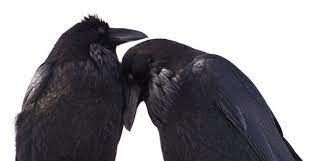
The Raven Revisited
This idea brings us back to Jesus’ words:
“Consider the ravens: They do not sow or reap, they have no storeroom or barn; yet God feeds them. And how much more valuable you are than birds!”
– Luke 12:24
The raven lives in the same uncertain world that we do.
It experiences storms, scarcity, and struggle.
Yet the raven does not worry about its existence.
It lives under the care of God.
Jesus uses the raven to invite us to see life differently.
Not as a desperate struggle to control our circumstances, but as a life lived within the care of God’s Kingdom.
Marriage on the Stage
This perspective has profound implications for marriage.
Marriage is one of the most meaningful roles we play in life.
But it was never designed to be our ultimate source of fulfillment.
When we expect our spouse to provide what only God can give, we place a burden on the relationship that it cannot carry.
Tim Keller once described marriage this way:
“Marriage reveals our deepest idols and selfishness so that God can transform us.”
In other words, marriage is not the final destination.
It is part of the stage on which God forms our character and teaches us to love.
When two people begin to understand that their ultimate identity and fulfillment come from God, their marriage can become something very different.
Instead of demanding from each other what only God can provide, they can begin to give to one another freely.
Living for Eternity
Spurgeon concludes his reflection with a powerful reminder:
“If this world is but a stage, then live as those who know the curtain will soon fall.”
One day, the stage will close.
Our roles will end.
Our possessions will fade.
But the Kingdom of God will remain.
This does not make life meaningless.
It makes life more meaningful, because it reminds us that the most important things in life are not temporary.
The most important things are:
- loving God
- loving others
- becoming the people God created us to be
Returning to Freedom
Jesus’ invitation to “consider the raven” is ultimately an invitation to freedom.
Freedom does not come from controlling our circumstances.
Freedom comes from trusting the One who holds our lives.
Jamie and Donna Winship describe this kind of trust through their own experience of suddenly losing nearly everything they had planned their lives around. Reflecting on what they learned about waiting on God, Jamie makes an important distinction:
“What he expects is not certain things to happen. He expects the Lord to be who the Lord says he is.”
— Jamie Winship
That may be at the heart of what Jesus is teaching us when He tells us to consider the raven. Our freedom is not found in knowing what God is going to do. It is found in knowing who God is.
The raven lives in freedom not because life is easy.
The raven lives in freedom because it exists within the care of God.
And Jesus says:
“How much more valuable are you than birds.“