Effects of Trauma on the Brain
As we explore several of the obstacles that keep us from experiencing the freedom of God’s Kingdom, understanding how our brains are designed to work and how it can be effected by trauma is helpful. Many of us, don’t even consider that perhaps we may have experienced any trauma or abuse primarily because that’s just “the way things were”. Or that any suffering or trial that we’ve had to deal with was just something to endure and get through with no purpose or value.
The Brain.
Science has discovered that the left and right hemispheres of the brain have unique and specific functions. Research generally identifies the left brain as the academic, logical brain and the right brain as the creative, intuitive brain. Studies conclude that learning increases at astounding rates when students integrate both sides of their brain during a lesson.
This diagram illustrates left brain and right brain functions. The brain splits up functioning, and then coordinates and synchronizes information processing between the two halves.

As a former Art teacher (about 100 years ago), I used to teach drawing in a very interesting way. I would place a copy of this drawing by the artist Picasso, in front of the student and I would ask them to re draw it.
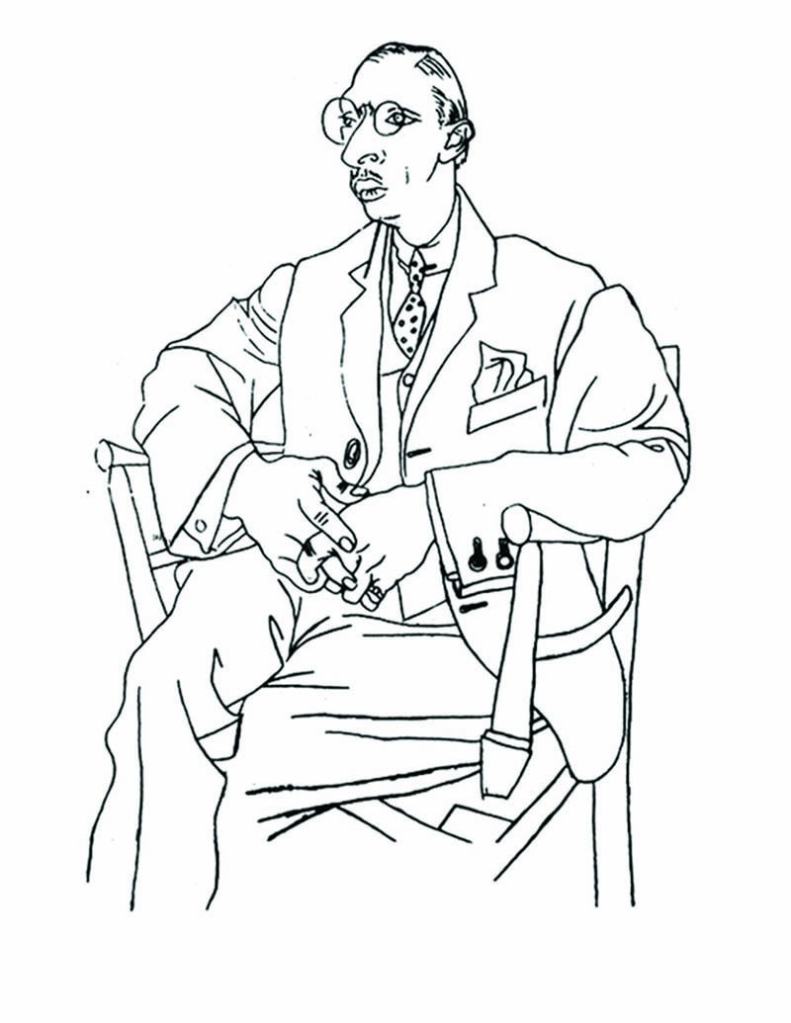
Without fail, (after complaining and saying “no way!”), students looked at the drawing, and with much trepidation, would make their first attempt to reproduce Picasso’s drawing as they “saw” it. Interestingly enough, most often what their finished drawing would look like is something like this:
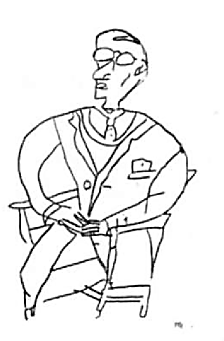
Then I would have the student turn the Picasso drawing upside down in front of them so they would be looking at the drawing upside down. Then I said, “Now reproduce it.” The drawing above is from the same student as the drawing below:
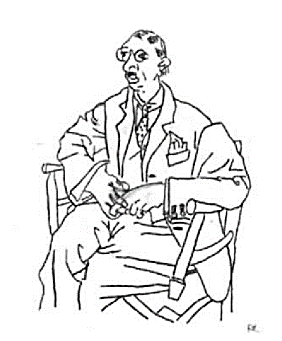
The left side of the brain processes visual cues, interpreting them as familiar patterns and symbols. By turning the reference picture upside down, it becomes unrecognizable, and the right side of the brain is forced to see the lines, shapes, and spaces, instead of seeing the object as a whole. The result is a drawing that replicates what they are “actually seeing” using their right brain, versus what their left brain “thinks” they are seeing. The more my students would train their brain to see using this method, eventually they began to be able to draw most anything freely, simply because they trained their right brain to see what was actually in front of them.
Think about the significance of this for a moment. In the same way, we can have a view of God that is only what we “think we see”. Both sides of our brain, when functioning the way it is designed, allows us to truly see and experience fully what God wants for us. When our control center in our brain is functioning the way God created it, our right brain connects to our left brain so we can access what we know to be true.
When a person has received appropriate healthy bonding at an early age, the left and right brain work in harmony to regulate emotion and process information. When trauma happens at an early age, disconnection happens. When there is a disconnect between the two halves, the right brain shuts down in current stressful situations and is unable to access what the left brain knows. This is why it is difficult to be “who you really are” in troubling current situations.
Expanding Our Understanding of Trauma
Not one of us has grown up without experiencing some level of trauma. I used to believe trauma was only what happened to other people. My understanding of what trauma was at best, limited, but for sure skewed. Yes, trauma can occur when awful things are done to us by bad people. But trauma can also occur by well intentioned people who just didn’t know what they didn’t know and in turn, we didn’t learn what we should have simply because we weren’t taught. Sometimes our biological family of origin has been unhelpful or even detrimental in our identity development.
“Traumas are the wounds (or injuries) left in our identities that render us less than what God had in mind when He created us. Trauma’s block growth. They block or slow proper maturity. ”
Jim Wilder, Living from the Heart Jesus Gave You
When it comes to living free, it’s vital that we recover from our traumas and to recover, we must first properly and thoroughly identify the wounds that occurred from those experiences and then learn to understand and embrace what James was teaching when he spoke about growing up in every way, “then we will be complete, not lacking in anything.”(James 1:4); or “count it all joy, my brethren, when you meet various trials, for you know that the testing of your faith produces steadfastness.” James 1: 2-3
Trauma A and B
(From Living From The Heart Jesus Gave You, Jim Wilder)
Type A trauma comes from the Absence of good things we should all receive, things that give us emotional stability.
- These absences create difficulties in relationships. Painful feelings surface when a person begins to realize the things they have missed.
- The areas of the brain most seriously affected by Type A traumas are the places where strong emotions are handled.
- Since the soul is primarily devoted to emotions, we can call Type A trauma fractures of the soul.
- Oftentimes, Type A traumas are given little attention. There importance to our development can be denied, leaving people puzzled about why they feel so awful about themselves and why they are afraid to trust. It’s as if we are born a blank slate, and no one ever writes on it letting us know who we are.
Type B trauma comes from Bad things happening.
- The brain is seriously affected by “B” traumas in the memory area, so it seems right to call Type B traumas fractures of the mind. If the bad events have left unresolved feelings or thoughts, the person cannot get back to a state of joy. That creates a fracture – a separation. Particularly bad events are mercifully forgotten, and amnesia protects the person from remembering them. Amnesia is an automatic brain function of instantly forgetting, that can be used protectively after age three. Before that, the brain is unable to establish a time or story line, so memories take a different form.
- When trauma reaches high intensity, it becomes overwhelming. Before the person is conscious of what is happening, the trauma is forgotten, and a blank spot in one’s memory appears. The person has no idea that the traumatic experience even happened. The person does not choose to forget the overwhelming episode, it is automatically lost to the memory as a way to cope with the pain. Although amnesia wipes away the pain for a time, it can be recovered at a later time. For healing to happen, the bad events or memories don’t need to be healed, only the lie based beliefs that occurred during the event.
- If these memory containers are not recovered, the corresponding lie based beliefs may continue to fester in your life. It takes identifying the wound, opening the hurt feeling enough to understand the effect of the trauma, and asking that the Lord replace any lies you believe with His truth.
Examples of Type A and Type B Traumas:
Type A Traumas:
- Not being cherished or celebrated.
- Not being delighted in.
- Not having parents who draw out and speak positive things into your identity.
- A lack of appropriate affection.
- A lack of boundaries and limits.
- Inadequate food, clothing, shelter, medical and dental care.
- Not being taught how to do the hard things, sticking with something until you
master it. - Lack of opportunity to develop personal resources and talents.
- Conditional love vs. unconditional love.
- A family system focused on “performance”. (this can be spiritual performance as well)
Type B Traumas:
- Physical abuse.
- Violent spanking, leaving bruises or emotional scars.
- Sexual abuse, including inappropriate touching, voyeurism, pornography or an
adult sharing sexual information. - Verbal abuse, belittling or name-calling.
- Abandonment by a parent.
- Torture or satanic ritual abuse.
- Witnessing someone else being abused.
When Trauma A or B Happens
- Disconnection occurs within the brain.
- Circuits that are needed in the brain to function properly, when not used, become more difficult to access.
- Right brain shuts down and we are unable to access what the left brain knows.
- Our pain processing pathway gets stuck.
- Negative messages and negative experiences release harmful chemicals into our bodies that cause physical issues.
- Core-lie based beliefs can manifest.
- We begin to see things and believe things that may feel true but aren’t.
Physical vs. Emotional Pain
- Scientists have discovered that emotional pain can produce the same effects in the brain as physical pain.
- When someone is abandoned, shamed, rejected, or emotionally abused, it can be more difficult to heal from the emotional and psychological pain.
Psychological Trauma
- Psychological trauma is a type of damage to the mind and soul that occurs as a result of a severely distressing event.
- Trauma is often the result of an overwhelming amount of stress that exceeds one’s ability to cope, or integrate the emotions involved with that experience.
- Includes an overwhelming experience (or repeated experiences), that is unexpectedly relived physiologically weeks, years and even decades later, as the person struggles to cope with their immediate circumstances. Such trauma almost always leads to serious, long-term negative consequences.
- If we have unhealed trauma, we begin to experience all the physical symptoms of a former trauma when something triggers us. This is a big deal and very stressful every time it happens.
- The good news is that Jesus has made a way for us to heal from both Type A and Type B trauma. As we heal, those situations that often trigger us decrease.
The Control Center
God created our brains to have a healthy identity. The brain’s control center (sometimes referred to as the joy center) not only regulates motivation, it regulates emotion in a way that keeps us “ourselves” in all situations. The main emotions the control center regulates are joy and the big six unpleasant emotions: fear, anger, sadness, disgust, shame, and hopelessness.
Jim Wilder, a Neuro Theologian, Licensed therapist, Author and teacher, in an interview with Michael John Cusick, talks about how our brain is formed from an early age and how our identity, character and joy center in our brains are effected and shaped. Listen in.

Think about what Jim was saying:
- Our brains need to be taught how to be human.
- Our brain when we are born was wired to look at faces, specifically the left eye of our parent, which most often would be our mom.
- There are over 200 muscles around the eye that are capable of showing “joy” and delight.
- We learned as an infant then, to look at the face of our parent to “delight” in us.
- At 5 months old, the infant discovers that the face looking at them has thoughts and impressions. And the infant begins to replicate them.
- Jim says; “The things that fire together, wire together.”
- Critical: Our brain as an infant, learns to mirror the parent.
- As an infant we have tons of moving parts and neurons rapidly growing in our brains, Jim makes the point; the one’s we use, get strengthened.
- At 4 years old, those things that weren’t used in our brains, get deleted.
- What we learn is that our brain is shaped to run and operate; speak and think according to the brain that we mirrored.
- This is very powerful in how both our left and right brain develop an identity and this is how our character is shaped and influenced.
Interesting to note: What if the person you relied on as an infant to “delight” in you, was depressed, abused, angry, disconnected, afraid, hopeless? How might that shape ones identity?
- Now put this identity development principle into perspective in your relationship with God. What if all we see of God comes from our left brain alone which as we are learning is knowledge based? Knowledge is good for us to help identify our errors. But if we stop there and only experience God intellectually, what happens to our identity?
- What will I become like if I allow God to develop my identity as the true me. Within an intimate attachment relationship with God? Using both my left and right brain?
- Without a full picture, we can develop who we are incorrectly because we focus our identity on how others see me, not how God sees me.
- We can embrace and grow in our ability to see ourselves as God sees us: He is delighted!. That is our identity.
- This is one of the purposes of community. To grow our capacity to live free and in joy through life giving relationships with others.
In the following audio clip we hear how God’s truth and God’s voice equals our true identity. They go on to discuss how our right and left brain has different perspectives regarding the concept of “shame”. Listen to this and think about which brain hemisphere you tend to respond with?

 Consider the Raven