
Building our Joy Capacity and Relational Circuits
What is joy? Often, we think of joy as happiness. The Bible provides us meaning that is an expression of God’s goodness and “completeness”, involving more than just happiness. It is a deeply rooted, inspired, and joy-filled contentment. The Apostle Paul in his letters in Philippians 4 writes about practical steps to help us engage in the platform that God has laid out for us in regard to experiencing joy. Bill Dogterom, Pastoral Ministries and Chair of Religion for the School for Professional Studies at Vanguard University, provides insight into the topic of what is joy.
Joy leaks, it can dissipate and if we’re not paying attention, joy can be used up. We need to regularly “re-joice”, to be filled up at the “joy station” so that our reservoir of joy is filled up. So that we have capacity for the life that you can’t plan for. Because remember, life is what happens when you were planning something else.
Bill Dogterom
Set aside 33 minutes to listen to this teaching from Bill Dogterom regarding joy by clicking the link below:
February 16, 2020 — Bill Dogterom
Finally, brothers and sisters, whatever is true, whatever is noble, whatever is right, whatever is pure, whatever is lovely, whatever is admirable—if anything is excellent or praiseworthy—think about such things.
Philippians 4:8
What is Joy Capacity?
Joy capacity is the strength to handle all situations. To illustrate the concept of joy capacity, consider the boulder and little rock below.
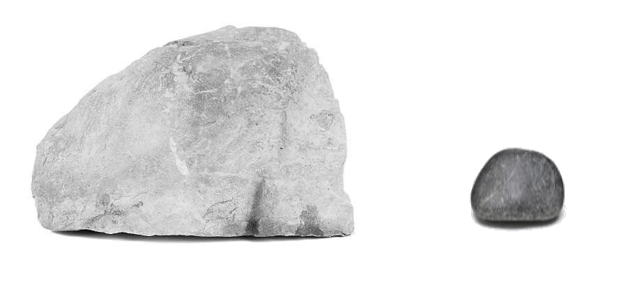
We need more joy capacity than the “hole” of our hurts and fears. The large rock represents one’s anxiety or lie-based beliefs (unresolved effects of trauma’s A or B in life), and the little rock represents the available capacity of joy that one has to overcome any “unresolved trauma.” If our capacity to return to joy is not larger (or stronger then our level of anxiety or lie based beliefs, we will struggle to return to joy in our current situations.
As you move towards wholeness and healing, you need to begin to build your joy capacity. If we try to address an unresolved lie-based belief or fill the “black hole” from trauma, our brain will automatically “kick you out” of that area until you have enough joy capacity to handle the memory and trauma without being retraumatized. Here is another way to look at it. Look at the image below. The 6 emotions on the “islands” around “JOY” are hardwired into the brain from birth. God created them for a positive purpose and to help us as we experience challenging or dangerous circumstances.
As you look at the joy ring below, to the extent that we get stuck on any of the 6 islands (Shame, Despair, Fear, Anger, Disgust, Sadness) without a bridge back to relational connection and joy, we lack the capacity to respond well to challenging relationships and circumstances. If we get stuck, our God-given emotions could become toxic if we are believing lies from the enemy. Fortunately, Joy capacity can be built or rebuilt through relational encounters with Jesus and others.
The larger words below are what God hard-wired into our brains. The small words in each circle are what happens when we can’t find our way back to joy and the God-given emotion becomes toxic.
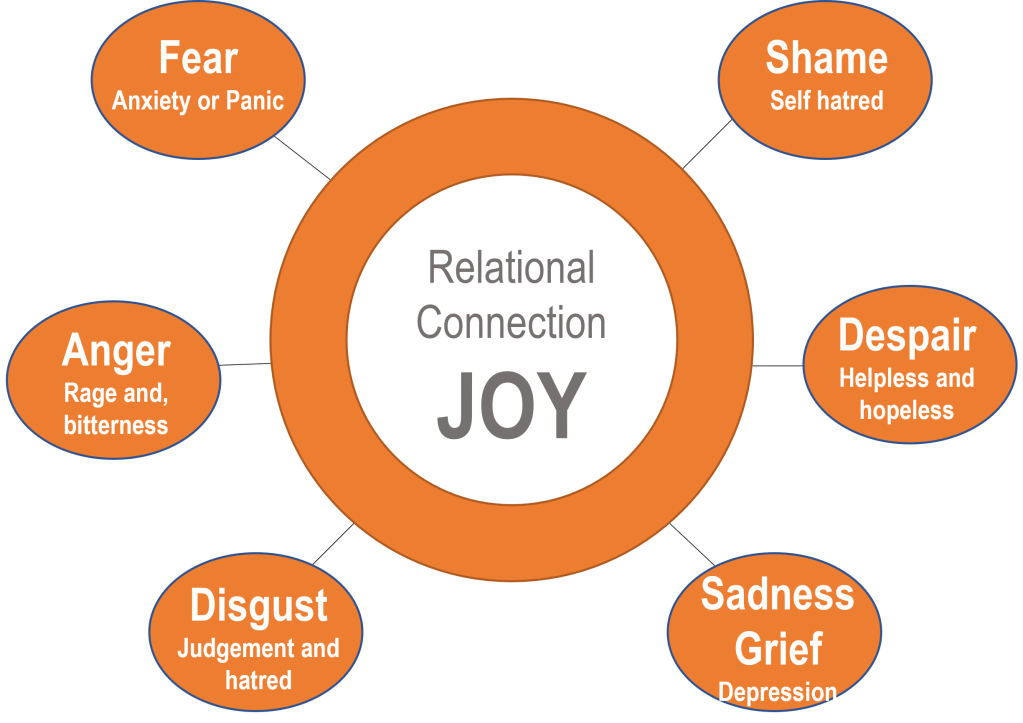
The Joy Ring
Any time we find ourselves on one of the islands of anger, grief, sadness, etc. The goal is for us to have the ability to return to the center, to return to joy.
Joy is in the center, but it is not hardwired at birth. Joy must be developed in relationship with God and with life-giving people. This is how our neuronal pathways back to relational joy are formed.
These emotions were designed by God. We need these emotions as they serve a purpose that God gave us. It’s when the emotions become toxic that creates the problem. In the chart below, the left column represents how God designed these emotions to work. The right hand column shows what can happen when the emotions become toxic.
| Anger–righteous anger against injustice and the anger we use to protect ourselves. | Toxic Anger might cause us to sin against another person. Buried anger & bitterness causes physical issues as well. |
| Fear – helps us to recognize when danger is present and to get to safety. | Toxic Fear causes us to live in anxiety and panic. |
| Sadness/Grief – alerts us to the loss of something/someone important (a need). | Becomes toxic when it leads to chronic depression and suicidal thoughts |
| Disgust – avoidance of something harmful. | Becomes toxic when it turns to unhealthy judgment of others. |
| Shame – alert to mis-attunement (feeling out of sync with another person or the Lord) | Unhealthy, toxic shame is when we get stuck and take on a false identity from the enemy. |
| Hopeless despair – stop trying something that can’t work. “It’s time to ask for help.” | If we don’t ask for help, we give up and feel hopeless in our situation. |
What often causes us to get stuck on any of the 6 islands and their corresponding toxicity, is caused by clinging to a coping mechanism or lie based solution. Often it is an anger solution that is put in place, which tends to cover up all other emotions and can block joy giving opportunities.
Some of us, when we find ourselves experiencing one of the 6 islands, simply push the emotion into a closet and shut the door to make us feel as though we are returning to joy. This is an illusion of contentment or peace as the closet will eventually get filled with so much junk, that no more can be stored there and ultimately will spill into the room.
As we learned from Bill’s teaching, at the beginning of this weeks content, God wants to join with us to use our pain, use our suffering, use our life’s experiences to bring hope and love to others who may be experiencing the same thing. Without learning how to return to joy ourselves, how can we help others experience the freedom that God intends for them? So learning how to return to true joy, as God defines it, is a big deal.
How joyful am I? How joyful are those around me?
This is a quiz from the book; Joy Starts Here. Written by Jim Wilder, E. Khouri, C. Courjey and S. Sutton. It is a series of questions for you to answer.
Each of these questions offer a range from 1-10. Take this quiz by circling the number that best fits where you are at. (This quiz can also be found clicking the week six question button)
- Every time something bothers me I talk to God until I feel better
Very Rarely 1 2 3 4 5 6 7 8 9 10 All the time
2. When things go wrong at my church, family, friends, community around me, I’m still at peace
Not Likely 1 2 3 4 5 6 7 8 9 10 I have solid peace
3. I feel God with me
Not at all 1 2 3 4 5 6 7 8 9 10 Consistently
4. Prayer helped me to see others differently many times this past year
Never 1 2 3 4 5 6 7 8 9 10 Constantly
5. Most of the time I feel very peaceful inside
Not likely 1 2 3 4 5 6 7 8 9 10 Constantly
6. My church family helps me find Gods perspective when I’m distressed
Never 1 2 3 4 5 6 7 8 9 10 Most of the time
7. I generally like who i am
Not at all 1 2 3 4 5 6 7 8 9 10 Most of the time.
8. I can clearly tell of times when God changed my perspective
Not at all 1 2 3 4 5 6 7 8 9 10 Many memories
9. I feel appreciation most of the day
Not at all 1 2 3 4 5 6 7 8 9 10 Most of the time
10. Love often moves me out of my comfort zone
Not at all 1 2 3 4 5 6 7 8 9 10 Most of the time.
Total up your scores in order of the questions.
What does your score mean?
The How Joyful Am I? / How Joyful Are Those Around Me? quiz measures relational joy capacity—the ability to remain connected, resilient, and emotionally steady in relationships. Rather than assessing happiness or personality, the scoring reflects how well you and the people around you sustain mutual delight, recover from stress, and maintain healthy connection under pressure.
Higher scores indicate stronger emotional maturity and a greater ability to return to joy after conflict or difficulty. Lower scores highlight areas for relational growth and resilience-building—not failure or diagnosis. The results provide a snapshot of your current joy capacity and the relational environment influencing it, helping identify opportunities to strengthen joy-based connection and community.
How can we learn to return to Joy?
Be deliberate with your “thoughts”.
Take time to deliberately think and pray about joy and consider what Bill talked about in his teaching; Have concrete ideas about the things you think about. Those things that are “true, whatever is noble, whatever is right, whatever is pure, whatever is lovely, whatever is admirable—if anything is excellent or praiseworthy—think about such things”.
The Apostle Paul had this to say about joy and contentment;
I have learned to be content whatever the circumstances. I know what it is to be in need, and I know what it is to have plenty. I have learned the secret of being content in any and every situation, whether well fed or hungry, whether living in plenty or in want. I can do all this through him who gives me strength.
Philippians 4: 11-13
Recognize it can be learned.
Paul points out two things here: Number 1. He had to “learn it,” and number 2. It’s a “secret”! We can open ourselves to learning and training ourselves to be content and return to joy in whatever circumstance we are in. It is a “muscle of our soul” and in its strength, lies the secret of true freedom and identity that God offers us. Remember, that God created our brains in such a way that this “muscle” can continue to grow throughout our life. “Contentment and Joy enables capacity for life at the greatest depth.”
Try to grasp God’s view and value of suffering.
Part of building the “muscle of our soul”, is to recognize and embrace, as we explored in week 4, God’s purpose for us in our suffering. As a reminder, listen to what Tim Keller says regarding Job and his suffering that we can learn from today.
Practice building joy with others.
Joy capacity is increased by practicing joy with healthy, life giving and loving relationships. As we have learned, even if a person has not received a healthy attachment at various development stages of one’s life, it is still possible for them to receive it from others, even later in life.
Remember: the part of the brain where joy grows continues to grow as we age. A brain with limited capacity will continue to pattern after a mature brain with healthy capacity. Ask God to introduce you to people who will help you increase your joy capacity with love, trust, and intimacy with the Lord.
Learn to turn your relational circuits ON.
(This is based on; Relational Circuits, Joy and Well Being, The Joy Ring and the Joy diagram are adaptations of the teachings of Margaret Webb and Dr. Karl Lehman, as cited in Immanuel Lifestyle Group Workbook)
Relational Circuits. What are they?
Our brains have circuits that guide our relational connections with God and with others. As the phrase implies, the concept behind relational circuits is similar to an electrical circuit. They can be ON, OFF or DIMMED. When ON, we have access to our most positive and productive aspects of our brain functions. When OFF, the opposite is true. When DIMMED, we experience only slightly of what is possible. These circuits are formed and strengthened through relationships.
This can be tricky.
When our relational circuits are off, we really don’t care to recognize that they are off. We typically become more rigid in our thinking and fight hard against anyone telling us we might need to change our current path. It’s like being on a sinking boat, but refusing to get off even though there is a guy in a life boat right next to you.
What is it like to have our relational circuits “OFF”?
- I just want to make a problem, person, or feeling go away.
- I don’t want to listen to what others feel or say.
- My mind is locked onto something upsetting.
- I don’t want to be connected to the person I usually like.
- I just want to get away, fight, or freeze.
- I aggressively interrogate, judge, and try to fix others.
Here are just a few things that your brain can do when your relational circuits are “ON”.
- Use all your senses
- Be flexible (instead of rigid) in your thinking
- Be self-reflective
- Attune with others, the person is more important than the problem
- Use willpower
- Be open and interested in what others think, feel and say
- Regulate emotions
- Work with others to reach understanding
- Focus & shift attention
- I am eager to talk with God about this situation – staying connected with God through prayer and his word.
Think about this for a moment and consider life without the ability to do some of these things. Relational circuits in the “ON” position, allow you to function in each of these areas. If your Relational circuits are in the “OFF” position, or even “dimmed”, each of these things would feel much more difficult to do than they should.
Here are more things managed when our relational circuits in the “ON” position.
- Distinguish between current and past events
- Allow for creative solutions to be found
- Help you to join with others to form groups
- Explore new solutions
- Process new data or input from others
- Respond instead of react
- Control cravings
- Resolve conflicts
- Access other brain and physical resources
- Set goals, remember goals, and enjoy reaching them
Even more when our Relational Circuits are ON:
- Develop a consistent identity
- Control or resolve fears
- Maintain & nurture consistent supportive, relationships
- Be resilient
- Be mindful
- Recognize what others are feeling & saying & why that might be important
- Consider that we might be wrong about something
- Access relational memories
- Receive from others
How do I turn my relational circuits on?
So, relational circuits being “ON” is critical for us to be able to function in the way God intends for us.
Learn to return to joy by building your joy strength. Remember it is much like a muscle. The more you practice and access joy, the more joy strength you build. Be aware when you aren’t being flexible, ask God to help you connect to Him. Spend consistent time with him, and in His word. Think about things that bring you joy, memories that were joy-filled. Reach out to other life- giving friends and family. Relationships, according to Karl Lehman, is one of the fastest ways to get your circuits back online. To have someone attune to you will provide a safe foundation. To do this they should have their circuits on, have the capacity to do so in that area, and be willing to help you to:
- feel seen
- feel heard
- feel understood
- feel that he/she is with you
- feel that he/she cares about you
- feel that he/she is glad to be with you
If you are able to experience the Lord’s presence you can also let him attune to you.
When I am afraid, I will trust in you, oh Lord. – Psalm 56:3
Gratitude also turns on our relational circuits
The Bible tells us, The joy of the Lord is your strength. – Nehemiah 8:10
The definition of Joy is relational connection. “Someone is glad to be with me.”
No one seeks treatment for joy reduction. No one worries about loved ones who are just too joyful. The problem is that people who are failing to thrive have issues, they live in conflict, and do not seem to know or remember that joy would be a natural and rewarding way to live.
One of the first goals in creating a family, or a relationship is to build around joy. While many families or relationships form around a shared fear or problem, this is not a desirable long-term plan. Joy is our deepest motivation and need. Joy needs to be the way we live.

 Consider the Raven